Here is our music video.

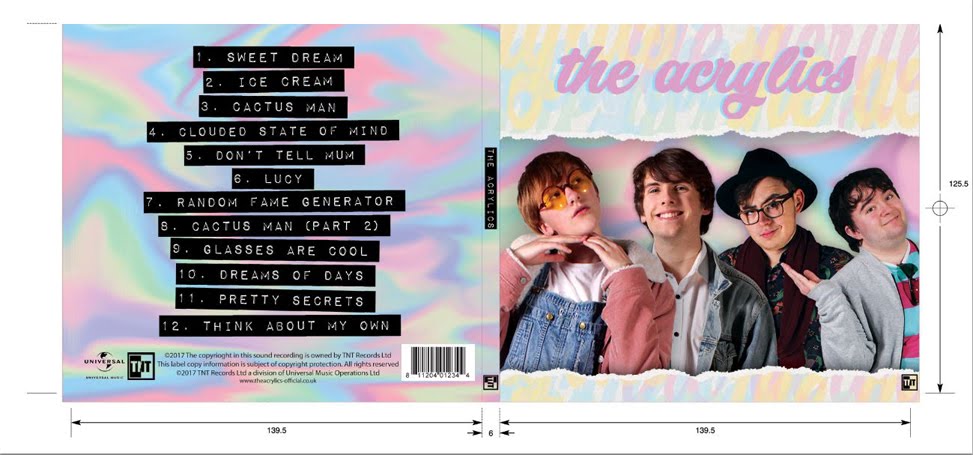
Here is the outside panel of my digipak album cover.

Here is the inside panel of my digipak album cover.

Here is the inside panel of my digipak album cover.

Here is a link to my artist's website. Please click on the image below to enter the website.

Tuesday, 7 November 2017

R+P Post 23: Planning my web pages

We decided that each of us would create our own potential web page design. We did this so that we could see which conventions of the websites we'd cited as influences we all agreed were important to add to the web page, and to see what aesthetics people chose so we could choose one that we felt best represented our band. 

Here are our designs:


After sharing our designs, we decided on the features of the website we wanted to add, which were:
  • A greetings page will pop up before the user can access the website that will promote the artist's debut album, thus immediately informing the user that it is for sale. Clicking on the greetings page will allow the user to go straight to where they can purchase the album.
  • An interactive slide show banner dominating the top of the home page, that begins with a slide promoting the new album, including a link that takes you to where you can purchase it. The user can then click through to slide through various other clear images of the whole band, with links to web pages such as the 'gallery' and 'videos' sections.
  • A 'one pager' layout; the majority of the content will remain on the home page, similar to the layout of a blog. The different sections, such as 'gallery', 'videos', 'shop' and 'about' will be segmented in the home page by a block/transparent box so that it stands apart from the other sections. 
  • A colourful, hand drawn/painted background, thus fitting the aesthetic of both the artist's music video and album cover. 
  • A navigation bar as the header of the website; this banner will remain at the top of the page as the user scrolls for ease of access, and each link on the banner will take the user down to the relevant section. 
  • The navigation bar will also include the band's name, written as the logo, and links to their social media accounts, which will appear as the icons of each company - Facebook, Twitter and Instagram. These icons, when clicked, will take the user directly to the social media page, where they can view the artist's latest news and follow them for more. 
  • Their social media will also be embedded into the home page as another section; we plan on integrating the Twitter feed into the home page.
Here is our final plan for our webpage:


R+P Post 22: Planning my promo shots

We decided to take promo shots both in a studio and on location. To schedule our studio shoots, we sat down with Tom and compared all our timetables to see when we were all free. We ran into some difficulty as we could only have all of us together for a forty minute period, but we agreed to focus on single band member shots for the other times so that we could focus on shooting all our whole band shots in this short space of time.

Prior to the shoot, we sat down and drew some rough ideas for what our character/whole band studio shots should look like. This would save us time coming up with poses in the real shoot. We planned to shoot close-ups, mid shots and long shots for each band member, and mid shots and long shots for the whole band.

We agreed that the studio shots of the band should focus on showcasing each member's character; for example, as Hugh is a goofy, energetic character, a lot of my character shots will involve me jumping,  giggling, pulling odd faces and fooling around with props. As for the whole band, we plan to portray the whole band as happy - smiley and arm-in-arm - so that they seem comfortable and enthusiastic together as a unit.

Inspirations for studio promo shots:


  • In a line, highlighting each member of the band.
  • Each member having their own expressions and personalities. 
  • Similar colour scheme, but a variant on the theme for each member. 
  • A mixture of professional (looking into camera) and unprofessional (laughing, smiling)

We agreed that the location shoots should be less fixed/serious that the studio shoots and have more of an 'insiders' perspective on the band members lives. These photos would be more personable and would be more relatable to audiences, portraying the band members less as pop stars and more like a normal group of friends. We planned for the members to behave more casual and free in these shots; for example, we decided that it was ok for movements to look slightly blurry or for people to be blinking, just as long as they looked like a classic day out for the band. We planned some shots between Casey and Hugh to capture their everyday sibling relationship, such as climbing a tree together and playing on the swings. Emilio kindly agreed to use his Nikon camera to shoot our 'out-and-about' shots, which we agreed should take place in locations around London to enforce our band's London roots. This included locations such as Embankment, Whitechapel and London bus stops and parks (most likely one close to our school).

Inspirations for location promo shots:


R+P Post 21: My key shots storyboard

To illustrate our ideas for our key shots, we created a storyboard. As our music video would contain very frequent cuts and a great number of shots, we decided to just draw the most important shots for each set up.

Here is the storyboard:

Our Storyboard 
We created our story board with post-it notes, and allocated a shot type to each colour. This helped us quickly see if we had a great enough variety of shot types in each set up, as it is a convention of music videos to cut between close to long frequently.

Our Key
We decided that for our band shots, we wanted to have a great deal of variety in how we framed the band. We decided to have a range of stationary long shots that allow the performers the space to show off their enthusiasm, and then have some mid shots/close ups that would be handheld, to allow for a more gritty, indie feel.

We create a lot of frames to illustrate our band shots

One of the influences for the change from still to handheld was Echosmith's 'Cool Kids'

Producing a storyboard helped us as we could visualise the specific movements of the performers and the camera in each frame (actions by performers we signified with a thin arrow, camera movements we signified with a thick arrow). This would help save time when we got to shooting as we would know in advance the rough actions we wanted to replicate.

Pinning down content of each set up also meant we knew what costumes and props to prepare; this was particularly helpful to us as our music video aesthetic is very hand-crafted, meaning a lot of our scenery would need to be made by us, so it was beneficial to know at an early stage what we needed to create in advance to our shoot.

For example, our planned shots for Alice in Wonderland included a variety of props, including a cardboard tree, a toy rabbit and a full length mirror

R+P Post 20: My Music Video Timeline

To plot out our music videos rough structure, we created a timeline. On this, we broke down the music video into timed sections, noting down our ideas for what will happen in each of these sections, including some preliminary shot ideas to help represent the action that will take place in these sections.

Here is our timeline:

Our Timeline
We decided that our basic structure for our music video would be the have the narrative be intercut between band shots, as well as solo shots of each of the band members, predominantly close ups/mid shots of the lead singer Casey singing.

We solidified our narrative whilst making the timeline: a girl dreams that she is visiting her brother, her best friend and her ex-boyfriend who appear as nostalgic characters that are important to her. We see how her break up with her ex leads her to comfort herself with her favourite things (Singing' in the Rain, Beatles etc.). In a short piece of narrative after the song ends, she gets a text from her new girlfriend Lucy, hinting that the future has more excitement in store.

The end of our timetable: here we decided on the closing of our narrative, deciding that to properly finish the story without contradicting the upbeat tone of the final chorus, it was best to add a few seconds of narrative to after the track ends
Creating a timeline helped us because it allowed us to organise specific timings for each of our proposed shots and set ups; we broke the timeline into two second long intervals, and noted down when the verses and choruses began and ended, allowing us to then work our set up ideas from our lyrics analysis around them. It helped us understand how the narrative of the video will flow, so we knew what would follow each scene.
The middle section of our music video timeline: the thick lines on the line signify where each chorus and verse begins and ends, the long lines are where we noted set ups and shot ideas, linking them with the lyrics at those moments
It helped us understand how the narrative of the video will flow, so we knew what would follow each scene.

We also got a better understanding on how the tone in certain moments in the song might contradict our preliminary ideas. For example, we first wanted our bridge to be an upbeat, colourful moment to lead into the party scene, but after making the timeline, we realised we needed to create a better scene to follow on from the break up between 'Alice' and 'Scorpion' in the previous chorus. We decided to intercut the colourful band shots with 'Alice' coming back to her apartment sadly and comforting herself. We found that this improved our music video as it transitioned between the parts of the song well, plus it better matches the intimate tone of the instrumentation during the bridge, which drops in texture and volume.

R+P Post 19: My influences and vision for the project

To visualise our preliminary ideas for our music video, we created a short video compiled of clips from music videos that influenced our vision for how our finished video would look. We called this our 'steal-o-matic', a moving 'pitch' for the aesthetic and video we initially wanted to achieve.

Creating this video was the best way to convey to others - peers and teachers - our idea for the music video so that they could then give us precise feedback. Another benefit of creating this video was that it allowed each member of our group to unify our vision so that we all were all on the same understanding of the aesthetic and content we wanted to achieve. 

Here is our steal-o-matic:


We used a lot of our influential bands and artists (e.g. Best Coast, Lily Allen, Sheppard etc.) as they all had the look we wanted to replicate, including the bright pastel colours in Sheppard's video for their song 'Geronimo'. 


We also included clips from the pieces of old media (e.g. Singing in the Rain, Mortal Kombat) so that we could begin to get a sense of the action that would take place in those moments of the video; for example, we decided we would replicate the lean Gene Kelly does on the streetlight. 


Tuesday, 31 October 2017

R+P Post 18: Analysis of my track's lyrics and instrumentation

One of the first things we did when we decided on our song was annotate a copy of the song's lyrics, highlighting what images and potential set ups they brought to mind.


The main refrains of the song are 'don't wake me up' and 'do you remember?'. These two phrases bring to mind images of intimate, shared experiences between two close people. We thought the song captured many independent moments where two people could easily share a 'iconic' memory ('the morning I was dancing in the rain'...'sitting under the old magic tree'). We also agreed that these memories seemed distant, and they were coming back to the artist in a dream like haze, hence the phrase 'don't wake me up'. 

We wanted to capture this by framing the narrative of our music video with our lead singer falling asleep, with most of the events in our story occurring in a dream landscape. This would illustrate the colourful way the artist remembers her fondest memories shared with close people in her life, which we decided would be her brother, her best friend, and her ex-boyfriend, all of whom are presented in the guise of famous characters across olden media. 

The keyboard is a signature instrument in this piece of music, and the synth effect on each of the chords give it a retro feel, taking the song out of the decade it was written and giving it an almost '70s aesthetic. This is why we chose to use similarly retro iconography by dressing our characters as iconic figures throughout history. 

Thursday, 26 October 2017

R+P Post 17: My Chosen Track

Our chosen track is the song 'Sweet Dream' by the indie band Black Cat Zoot.


Black Cat Zoot


Black Cat Zoot are a German indie/alt rock band who formed in Munich in 2005. They strive to innovate a unique sound of 'pop' music that revives the sound of classic rock with a modern edge. 


On their website, they had this to say about their approach to music making:


Sweet Dream is a song on their album 'Mutable Transformeract', which was released on the 29th April 2011. 


The album was produced by Hazelwood Music Production (f.1996), a German record label based in Frankfurt that produces obscure indie music. Although on their website they do not say that they focus on producing a specific genre of music, the most popular genre that they produce tends to be that of indie rock and pop. The album was recorded in Hazelwood's own recording studio.


We chose this song because we really enjoyed the innovative approach to the indie pop genre, with the quirky instrumentals and nostalgic lyrics mixing well with the catchy melodies that are associated with pop songs. 


We believe that this will appeal to our target audience of indie pop fans, for it is very obscure and thus appeals to their appreciation of discovering lesser known artists who produce pop music. 


We also believe this will appeal to our audience of young women and teenage girls because the lead vocalist, Lisa Milla, is a female and our survey to our target audience suggested that a substantial amount of young people appreciate it when the artist shares the same gender as them (26%). 


As for copyright information, as the song was released for free download on their website, there should be no problem in seeking permission to use the song.